
Insight
Wilko’s Collapse: How Do You Value a Business When the Numbers Start to Deteriorate?
14 September 2026 · 12 min read · Platform01 Consulting Global
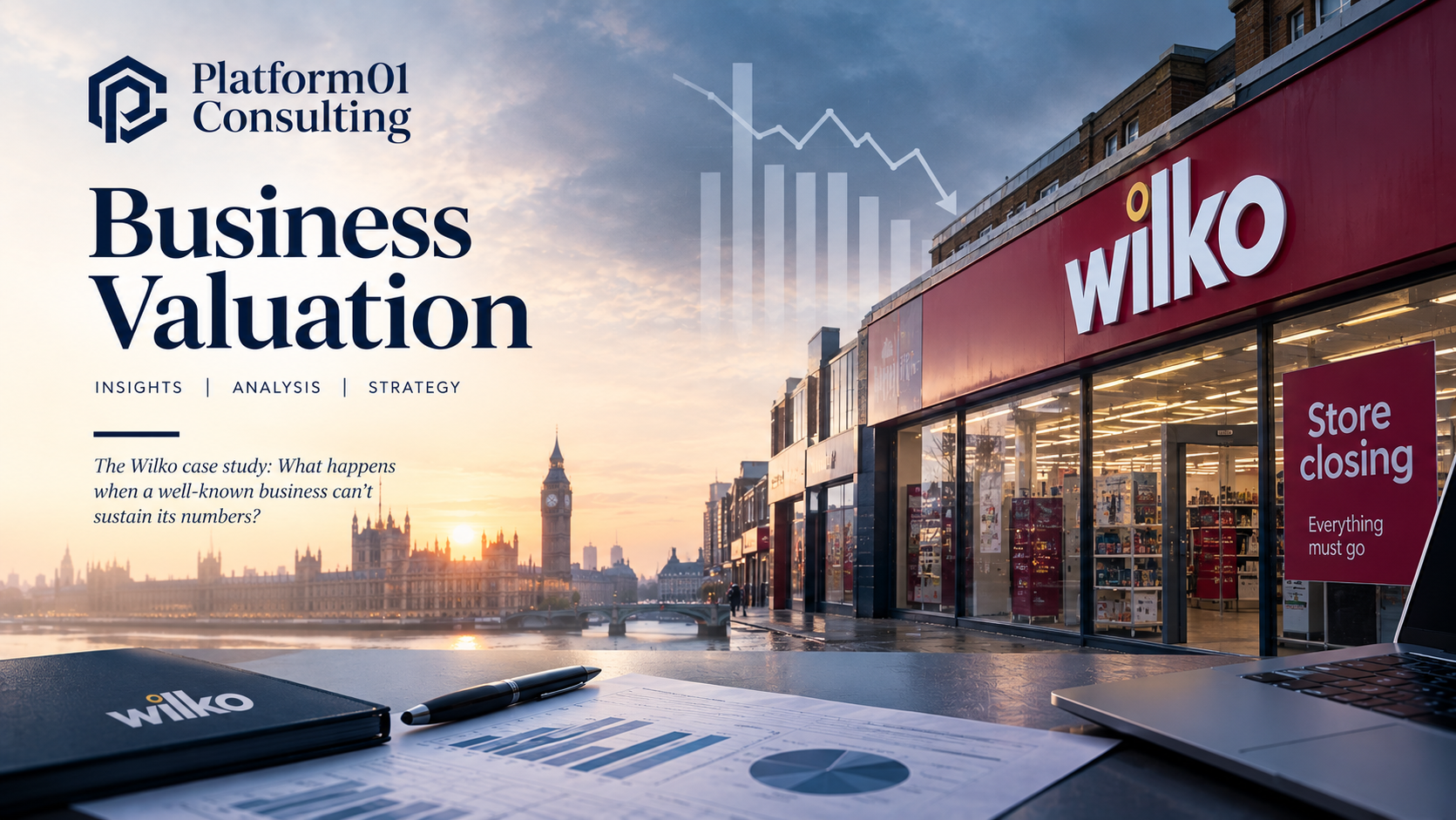
Wilko was once one of the UK’s most recognisable high-street retailers, with hundreds of stores across the country and a strong position in the value retail market. Yet in 2023, the company collapsed into administration, ultimately closing its stores and bringing an end to a retail business that had operated for more than 90 years.
Wilko’s decline provides a useful case study in business valuation: what happens when a company still has substantial revenue, a recognisable brand and a large customer base, but its underlying financial performance is deteriorating?
For investors, shareholders and management teams, this is where valuation becomes far more complicated than simply applying a multiple to revenue or EBITDA.
The Wilko Story: From High-Street Strength to Administration
Wilko had built its business around affordable household goods, homeware, DIY products and everyday essentials. Its extensive store network and established brand gave it significant visibility across the UK.
However, the retail environment became increasingly challenging. Rising operating costs, changing consumer behaviour, increased competition from discount retailers and the shift towards online shopping placed pressure on traditional high-street retailers.
Wilko’s financial position deteriorated significantly. Its 2022 accounts showed annual revenue of more than £1 billion, but the business was also reporting substantial losses.
This creates an important valuation question:
If a company generates more than £1 billion in revenue but is losing money, what is the business actually worth?
The answer depends on what those numbers say about the company’s future — not simply its past.
Revenue Does Not Equal Business Value
One of the most important lessons from Wilko is that size and value are not necessarily the same thing.
A business can have:
- Significant annual revenue
- A recognised brand
- Hundreds of physical locations
- A large customer base
- Valuable supplier relationships
…and still have limited equity value if its future cash flows are insufficient to support its liabilities and operating requirements.
A company valuation therefore needs to look beyond turnover. A business valuation service company would typically consider factors such as profitability, cash generation, debt, working capital, assets, market conditions and future growth prospects before reaching a conclusion.
In Wilko’s case, the deterioration in profitability fundamentally changed the valuation conversation.
The Importance of Future Cash Flow
A traditional discounted cash flow (DCF) valuation is based on the principle that a business is worth the present value of the cash it can generate in the future.
That becomes particularly challenging when a company’s forecasts are deteriorating. For example, imagine a retailer forecasting:
- Revenue → stable or growing
- Margins → declining
- Operating costs → increasing
- Cash flow → weakening
- Debt requirements → increasing
A revenue-based valuation might still make the company appear large. A cash-flow-based valuation could tell a very different story.
This is why business valuation consulting becomes especially important when a company moves from a growth or stable phase into financial distress.
What Happens to Valuation When a Business Is Distressed?
For a healthy company, an adviser may use several valuation approaches, including:
1. Discounted Cash Flow
Future cash flows are forecast and discounted back to today’s value.
The difficulty is that distressed businesses often have highly uncertain forecasts. Small changes to margins, working capital or restructuring costs can produce significant differences in valuation.
2. Comparable Company Analysis
A valuation can be benchmarked against similar publicly listed or recently transacted businesses.
However, distressed companies may not be comparable to healthy businesses operating in the same sector.
3. Precedent Transactions
Recent acquisitions of comparable companies can provide useful market evidence.
Again, the circumstances of the transaction matter. A strategic acquisition of a profitable retailer is fundamentally different from an acquisition of distressed assets.
4. Asset-Based Valuation
When future earnings become difficult to predict, the value of individual assets may become increasingly important.
For a retailer, this could include inventory, property interests, equipment, intellectual property and the brand.
In a distressed situation, however, the value of those assets may depend heavily on whether they are sold as part of a functioning business or separately.
Wilko Demonstrates the Difference Between Enterprise Value and Equity Value
Another important lesson is the distinction between enterprise value and equity value.
Enterprise value broadly represents the value attributable to the operating business before considering the capital structure. Equity value is what remains for shareholders after relevant debt and other claims are taken into account.
This distinction becomes critical when a company has substantial financial obligations.
A business may have a valuable brand, stores, inventory and customer relationships, but if its liabilities exceed the value available to equity holders, the shareholder value can become extremely limited.
This is one reason why a company valuation expert must analyse the balance sheet alongside the income statement and forecasts.
What Happened to Wilko’s Brand?
Wilko’s collapse also illustrates that the value of a company is not necessarily the same as the value of its individual assets.
Following the administration, elements of the Wilko business were acquired separately. The Wilko brand and intellectual property were acquired by CDS Superstores, the owner of Poundland, while other assets and operations were dealt with through the administration process.
This highlights an important principle:
A distressed company can have valuable individual assets even when the original corporate structure is no longer economically viable.
The brand may have customer recognition. Inventory may have liquidation value. Store leases may have strategic value — or significant liabilities attached to them. Intellectual property may be valuable to another operator.
The valuation therefore changes depending on what exactly is being valued and under what circumstances.
What Could Investors Have Looked At Earlier?
Wilko’s case demonstrates why valuation should not be treated as a one-off exercise.
For investors and business owners, several indicators can provide early warnings:
- Declining margins — revenue growth becomes less meaningful when each pound of sales generates less profit.
- Weakening cash flow — accounting profits can look different from the actual cash available to operate the business.
- Increasing financial pressure — growing borrowing requirements can significantly affect equity value.
- Rising operating costs — for a physical retailer, rent, wages, utilities and logistics can have a major impact on sustainable margins.
- Changing competitive dynamics — a company’s historical market position may not translate into future pricing power.
These factors are particularly relevant when undertaking professional services business valuation UK assignments, where the objective is not simply to calculate a number but to understand the assumptions supporting that number.
The Key Valuation Lesson from Wilko
Wilko’s collapse demonstrates that valuation is ultimately about sustainable future economics.
A business can be famous, large and commercially significant while simultaneously becoming less valuable from an investment perspective.
For a business valuation firm, the critical questions are therefore:
- Can the company generate sustainable cash flow?
- Are current margins economically viable?
- How much investment is required to maintain the business?
- What liabilities need to be considered?
- Are current problems temporary or structural?
- What would the business be worth under different scenarios?
- Does the value lie in the operating company, its assets, its brand, or a combination of these?
These questions become even more important when the business is facing restructuring, refinancing, a potential sale or financial distress.
How Platform01 Approaches Business Valuation
At Platform01 Consulting, we view valuation as more than applying a market multiple to a set of financial statements.
Our business valuation consulting firm approach combines financial analysis, commercial assessment, market research and scenario-based financial modelling to understand what is driving value — and what could destroy it.
For companies experiencing declining performance, valuation can help management and shareholders assess different outcomes before making critical decisions.
Whether the requirement is for an investment decision, transaction, shareholder purposes, restructuring or strategic planning, working with experienced valuation advisory firms can provide a more robust basis for decision-making. Our business valuation and business planning services are built around that principle.
Wilko’s story is a reminder that the most important valuation question is not “How much revenue does this business generate?”
It is:
“What sustainable economic value can this business generate in the future?”
That distinction can mean the difference between recognising a temporary downturn and identifying a fundamental decline in business value.